Blogs

Who or what is God? Words can only say so much about who God is or what God isn’t. Thankfully our thinking isn’t limited to words. Through Art Theology -- using the creative languages of the arts -- we can form new ideas, questions, and perceptions about God. Let the words go and think in color. Thinking back to the very first ideas of God you ever had, what color comes to mind? Gray... Gray was the color of the beard of the old man in the sky, the first image I had of God the Father. Gray was the color of the clouds he sat on. In painting this first idea, I used cold, dark, black grays illustrating the vast remoteness of this idea of God. I began incorporating yellows and whites and softening places within the gray, creating warmth in the painting. As I did so I recalled my childhood struggle to comprehend how this cold, dark, mysterious God also made me and loved me unconditionally. [caption id="attachment_247214" align="alignnone" width="467"] The Cloud of Unknowing Angela L. Hummel 11x14 Acrylic on Wood[/caption] My concept of God changed when I was introduced to the idea of Jesus and the idea of God’s personal love. The gray remains but softens even more and I introduce an abstract brown line. God’s love expressed through Jesus felt so intimate and personal that I have at times a sense of knowing the nook of his neck, of having rested my head upon that shoulder line. Yet, I could not tell you what his eyes or nose look like. In some ways I do not know him at all. In other ways, that personal love of God is the most real thing in my experience. [caption id="attachment_247215" align="alignnone" width="390"] Personal Love Angela L. Hummel 11x14 Acrylic on Wood[/caption] Stepping back and looking at the first two paintings I felt a new question arising. I was physically uncomfortable as I reflected on how masculinely gendered my ideas of God had been. No matter what we think and understand theologically about God language, we carry these memories in our bodies. I felt myself reaching for new colors and lines: purples, blues, gold, and undulating lines. This next painting incorporates my reflections on Shekinah. Both women and men are made in the image of God. The divine feminine reveals a love that conceives, gestates, labors, births, nurtures, and sustains. [caption id="attachment_247216" align="alignnone" width="467"] Shekinah Angela L. Hummel 11x14 Acrylic on Wood[/caption] God is love. This love is mysterious, personal, intimate, boundaried, male, female, non-binary, fluid like water, beyond our comprehension. How can we reflect the love of God and learn to love in this dynamic way? Regardless of bodily function, all of us can learn to love more deeply by reflecting on how love conceives, gestates, labors, births, and sustains. The Christian focus on moral theology has led to judgmentalism that has caused some people to reject religion. Why don’t we devote as much attention to Christian love -- what this love is and how we live it? We need new ways of exploring this vast idea. We need Art Theology. Art Theology has helped me to move away from a monologic pedagogy into a dialogic way of teaching. When my students paint the colors and lines of their thinking about God they move into new ideas, questions, and dialogue that discursive reasoning alone could not take us into. The understandings that we have arrived at through this method have transformed my classroom into a dynamic place of collaboration where together we have learned to see God as truly other, for who God is, not constrained by our previous limited definitions and arguments. Angela L. Hummel
Elias Ortega-Aponte, Ph.D. Assistant Professor of Afro-Latinos/a Religions and Cultural Studies Drew University As I geared up to teach two social justice themed courses this Fall, my summer preparations were disrupted by the news of two tragedies and the reflections they prompted. First was the death of Omar Abrego, beaten to death by police on August 2 in Los Angeles. Witness reports claim that Abrego was taken out of his car and beaten up by two police officers for at least 10 minutes, and left in a pool of blood. The father of three would die hours later in a
Before the quarantine caused seismic interruptions, a cloistered education was deemed by many as the better education. This longstanding approach to education meant that the student would sequester from the world, study undisturbed from the goings-on of the world, to then emerge and return to the world as a learned person. The time away from society, family, and many kinds of communal obligations was meant to provide time for intellectual maturation, contemplation, and some say, an extended adolescence. The students would be free to read, write, and think while under the watchful eye of a teacher. In the cloistered model of education, the degree taken (wrestled and snatched) afforded the recipient a select spot in the ranks of the higher echelons of society. The focus of education as secluded and separate from society is evident in the language of students. Students talk about the classroom as being “in here” while their lives are “out there.” Students, in rebuffing some ideas, comment “that won’t work in the real world” or “that’s nice to discuss, but in the real-world people will not go for that.” The classroom, for these students, is not the real, while life in society, in community, with family obligations and responsibilities is the real. Students also signal that what is taught in many classrooms has little relevance to the problems and pain of their people. Or what they learn requires a great deal of translation, interpretation, and adaptation to be relevant to the suffering of their people. The primary aim of cloistered teaching is to insulate student and teacher until which time that the student has met the disconnected standards of the faculty. In this time of shifting models of education, these kinds of new questions abound: Suppose the aim of education is not to hide from the world in order to emerge as an educated person, but instead the better aim is to prepare to meet the needs of the world as education? Could this moment be forcing us to a collective realization that the better aim of education is to engage in the world as education and thus change the world? What is the relationship between communities of learning and social change? What is the influence of the world upon classroom teaching? Moving forward, what will be the relationship between communities of learning and the world? What will be the relationship between schools and the very neighborhoods, towns, and cities they occupy? What if the world is the classroom? What practices of communities of learning are needed for social innovation? What meaning-making practices, understandings and joys of the world are needed to facilitate vibrant learning in schools? Yes, many schools have forms of internships, field education, supervised vocational experiences, elaborate field trips, or study abroad while in a degree program. Most of these programs are auxiliary to the degree program and if not auxiliary the experiences which keep students in the world or send students into new worlds are not the spine of the curriculum. The primary presumption of current models of higher education is that student’s first learn theory in a classroom (cloistered), then are sent out into the workplace to practice. There is still a separation and privileging of theory over practice. Howard Thurman informed us years ago that theory and practice are each sides of the same coin. What would it mean to create approaches to education which do not separate theory from practice or student from community? A small start to answering this critical question has to do with the mindset of the students while in a degree program. The identities and social locations of my students has always been a significant factor in my teaching. I wanted my students to come to class and bring with them into the course conversation the joys, suffering, trouble, practices, learnings and know-hows of their people, their communities. I believed that students, to have agency in their own learning, must not leave their families nor society for education, but they must reflect critically and imaginatively on the struggles of their community looking for new and needed solutions. To facilitate this approach, I designed this learning exercise for my introductory course: During the second session of the course, I asked students to reflect upon these questions: (a) Who are your people? (b) What sacrifices did your people make for you to be in this educational experience? (c) What problems plague your people? What problems have their backs against the wall? Once these questions were engaged, I would instruct them to draw a metaphor or simile to depict your people and their current social situation. I chided them not to reduce the complexity of the situation, but to use a metaphor which depicted the complexity. I gave them time to think and draw. Finally, I asked these questions for further reflection and preparation for our semester long conversation: (a) What kind of leader will you need to become to assist your people and relieve their suffering? (b) What leaders will you join for the thriving of your people? Using their drawings and prose we created a gallery wall in the classroom. I encouraged them to, for the entirety of the semester, keep their families, churches, neighborhoods at the center of their experience in this degree program. Throughout the course I insisted that they not think generically nor individualistically as if they were at school alone or disconnected from the world. Throughout the semester I led them in other learning activities and assignments where they had to continue to consider the specific problems, troubles, challenges, and attributes of their people and ways our study informed those troubles and fostered their leadership formation in their own context. We do not have the luxury of disconnecting our best minds from the troubles and support of their families and neighborhoods while undertaking higher education. We need models of education which nurture interconnection, understands community and promotes a sense of belonging as a necessity to healthy society.
Driftwood on a beach. How did it get here? From where? When? Why this beach? Why this day? And also, that it arrived, on the foam, with a bounty of neon green moss, stubbornly shining a light in the soggy sand. A beacon. Life will out. Blog originally posted in April 2018

As religious and theological educators, one way to encourage democratic formation among our students is to teach about democracy, especially about the historical relationship between religious institutions and democracy. Another way is to provide opportunities for students to practice democracy. In other words, we might consider how our classrooms and assignments can provide opportunities for students to engage in democratic practices. Both seem important to democratic formation among students. In the United States, one way to describe a civic association, religious institutions having historically been the largest share, is a school of democracy. While this Tocquevillian view has its critics, social scientists claim that participating in civic associations can cultivate a set of civic beliefs, dispositions, and practices that will contribute to a robust civic life. For example, participation in civic associations can generate citizens’ ability to care for one another, care about public issues, and learn how to deliberate about these public issues. They are also thought to generate what Robert Putnam calls “social capital,” which is created when citizens learn the norms of reciprocity, build networks, and build trust. Social capital is needed for citizens to come together to work on common projects, build broader cross-group networks, and join together to hold elected officials accountable. What makes something—an institution, organization, workplace, classroom, or community—democratic? I recently discussed this question with a student as she prepared to facilitate the week’s discussion of Jeffrey Stout’s Blessed are the Organized. As we discussed the text, she compared two organizations she has worked for. Transparency and shared decision-making were features that she felt made her current organization more democratic than the other. Practices of shared authority, shared responsibility, transparency, and accountability are all part of what organizing people democratically looks like. Providing students with examples and theory helps them evaluate the organizations and institutions that they are currently a part of or help lead. It can also cultivate their moral imaginations as they envision reforms or their broader vocation. Further, teaching students about the civic and democratic practices of religious institutions is fundamental to cultivating a moral imagination. Churches played a significant role in the grassroots organizing of the Civil Rights Movement, for example. Our students should not only study the moral reasoning that motivated this civic work but also the organizing practices and the principles that structured these movements. This includes analyzing instances of undemocratic authority and accountability within movements, such as the gendered disparities within certain spheres of the Movement. Contemporary examples are crucial too. C. Melissa Snarr’s All You That Labor is an ethnographic study of the role that religious organizations played within the Living Wage Movement. In addition to being a more contemporary example of broad-based organizing, this study illustrates how religious institutions can help frame the moral language of a public issue. This, too, seems important for helping students develop a moral imagination and prophetic voice. Teaching about democracy, however, is not the only way we can imagine our role as theological and religious studies educators. Rather, our classrooms can also be places where students are able to practice democracy. In my ethnographic study of a public high school in Brooklyn I found several examples and a robust culture of shared authority and shared responsibility among teachers and students. I borrow this way of framing democratic education from Amy Gutman, but it is also deeply related to broader traditions of liberative or critical pedagogies. In my spring course, I incorporated a practice of shared authority and responsibility. Students were divided into small groups of five to six and each was responsible for facilitating the discussion for one week. I met with each student prior to their day of facilitation, and during class I observed. This structure, I believe, is one way to share not only authority with students but also to share responsibility. Students are authorized to share in the responsibility of how the learning unfolds not only with the professor but also with their colleagues. To make these aims more explicit, I asked students to complete a short feedback form after each discussion. One of the questions was: How much more do you feel you understand the content after the discussion? Students could rate on a scale of 1-5 with 1 being “about the same as before” and 5 being “much more than before.” Another question was: How collaborative was the knowledge production and discussion? Students could rate on a scale from 1-5 with 1 being “little to no collaboration” and 5 being “very collaborative.” My goal was to make the aims of the discussion clear: collaborative knowledge production. In this way, I hoped to cultivate a shared responsibility among the group members for understanding, critiquing, and applying the week’s content. While some students incorporated this language and framing into their written feedback, I could have done more to incorporate this as a practice central to the aims of the course. As I reflect on how to revise this practice, I am eager to incorporate other ways to practice shared authority and responsibility within the classroom.

I can’t afford a boat but I can rent one. I spent a day on the water with my wife, Dr. Vanessa Watkins, her sister Dr. Adriana Higgins, and my brother-in-law, Rev. Michael Higgins. This time with family and friends doing something out of the ordinary, inspires my creativity. I had never been out on a pontoon boat before and never driven a boat; but, here we were having fun, laughing, talking and enjoying each other. It was one of the most relaxing times of my life. I cannot quantify how this might have affected my creative energies, but I know it did. A big part of being creative is enjoying life, having fun and relaxing. When we are able to relax, we allow our brains to rest and be restored to create. I encourage you as a teacher, professor and creative to make time to do new things with family and friends. It will bring joy to your life and invigorate your creativity. Caption: My family and me on a pontoon boat in Red Mountain State Park, Ackworth, GA. ©Ralph Basui Watkins
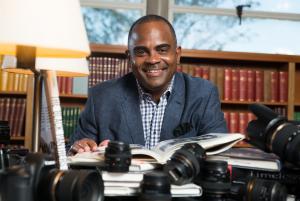
When I got my PhD in 1997 and began my teaching career we were just being introduced to PowerPoint. I like many others remember those days which have long since gone. Over my career we have moved from the use of PowerPoint to teaching in classrooms where students have laptops, tablets and phones. Students are engaging life through the screen. What does it mean to teach in an age where our students are being shaped by what they have in their hands? How do we focus our teaching in light of our student’s reality of living in an age where they are learning via moving and still images? How does our teaching align with how they see the world via Instagram, YouTube, TikTok and Facebook? We live in a world where, “…three hundred hours of YouTube video are uploaded every minute. Six billion hours of video are watched every month on the site, one hour for every person on earth. The 18–34 age group watches more YouTube than cable television. (And remember that YouTube was only created in 2005.)[1] “Every two minutes, Americans alone take more photographs than were made in the entire nineteenth century.”[2] We have become a world of image makers and these images have become our primary way to engage the world, learn about the world and our students are visual learners and much of our teaching is literate and oral. I propose that we embrace the visual world and learn as our students learn so that we can become more effective pedagogues. In his book How to See the World, Nicholas Mirzoeff articulates aspects of the contemporary visual age and provides insights about the history of visual media since 1930: As early as 1930, an estimated 1 billion photographs were being taken every year worldwide. Fifty years later, it was about 25 billion a year, still taken on film. By 2012, we were taking 380 billion photographs a year, nearly all digital. One trillion photographs were taken in 2014. There were some 3.5 trillion photographs in existence in 2011, so the global photography archive increased by some 25 percent or so in 2014. In that same year, 2011, there were 1 trillion visits to YouTube. Like it or not, the emerging global society is visual. All these photographs and videos are our way of trying to see the world. We feel compelled to make images of it and share them with others as a key part of our effort to understand the changing world around us and our place within it.[3] So, what does this mean for me and what does it mean for us? For me it has meant a complete shift in how I teach. I have moved from thinking first about lecture, words, reading and content to thinking visually. How will I engage the eyes of my students so that I can touch the mind of my students? How can I help them see what we are thinking about in this course as it lives in the world as an image that expands their imagination? Imagining the image expands the imagination of students who live in a world of images. The image becomes the lens by which my students enter this world on a daily basis therefore I start with them in my viewfinder. I see them as they see the world and because this is their starting point it is my starting point. I am teaching with them in sight, I see them looking at their phones, I see what they see and as they see so that I can teach in the visual language that they understand. My students sleep with their phones beside their beds and before they brush their teeth in the morning, they pick up their phones and start their day looking at images. I want my courses and my content to be on their home-screens. This is the world in which we live, this is the age in which we are called to teach. I had to change how I see my teaching so that my students could see what I am trying to get them to engage. This has been a major shift for me. It called me to go back go to school to learn how to see so that I could become an effective teacher in the visual age. I talk about my shift and embrace of the world in which we live in the short video that accompanies this Blog. In this video we are celebrating my installation in an endowed chair. The video speaks to the shift I have made, and I invite you to consider. What does it look like to teach in the visual age (pun intended)? Teaching in the Visual Age: Dr. Ralph Basui Watkins from Ralph Watkins on Vimeo. [1] Mirzoeff, Nicholas. How to See the World (4). Basic Books. Kindle Edition. [2] Mirzoeff, Nicholas. How to See the World (4). Basic Books. Kindle Edition. [3] Mirzoeff, Nicholas. How to See the World (4-5). Basic Books. Kindle Edition. *Original Blog published on December 11, 2019

In a seminary setting with a daily rule of prayer, students and professors can easily fall into a trap of distinguishing between teaching students how to advocate for justice in the “real world” and the “in-church” liturgy of prayer and worship of seminary life. At times, the liturgical rhythms might even appear to be an intellectual or temporal straitjacket: hindering the work of classroom learning or service to the community and work for justice. However, in my own experience teaching in both Roman Catholic and Episcopal/Anglican seminaries, where the traditional Christian liturgy of the hours determines the structures and rhythms of the students’ lives and learning, I have found that teaching social justice in synergy rather than opposition to the liturgical tide has provided opportunity for teaching social justice rather than a hinderance. In fact, this immersion in the liturgy can transform teaching social justice into an act of recollection and connection building, rather than creating an oppositional dynamic. This “calling to mind” in beginning to teach social justice which immersion in liturgy permits has two crucial components. First, the daily liturgy of the Roman Catholic and Anglican tradition provides substantial content for beginning to discuss and understand the need for social justice and its objects. While there are calls to pursue justice throughout the scripture, the liturgy of the hours or of Morning and Evening Prayer, creates a special focus on the book of Psalms. In these liturgies, students will generally read in unison throughout the entire book every month, and then turn around and do it again. This means that students begin and end almost every day with the cries to instantiate God’s justice which fill the Psalms in their mouths and in their minds. Beginning a pedagogical engagement with social justice in the Christian tradition therefore begins with an acknowledgement of the Word which is already in their mouth, and then broadens to seeking to understand that word in the context of the present day. This grounding of the classroom discussion of social justice in the liturgy is, of course, far from novel, but stretches back through the Christian tradition. Explaining this tradition and explicitly linking it to their own immersion liturgy then prepares students for the task of analogical translation into their own world, of the ways in which Christians, from John Chrysostom through abolitionists to the Oxford Movement to Oscar Romero, have seen the liturgy as the point of departure out into the world to seek justice and serve the poor. Just as important as starting a discussion on what God’s justice might demand of them is helping them understand how their formation in the liturgy has better prepared them to work for social justice in the world. By its very nature, formation in liturgical worship demolishes the temptation to autonomy and the urge to seek the spotlight, and rather trains students to be communal, listen to others, and be patient with the small steps and slowly developing processes. For example, when students are taught how to chant the Psalms in choir, they learn that the goal is never to declaim, to take up the most space, to push their own voices forward. Rather, they are taught to listen to the tones and pitches of others, to join in the one communal sound, and to use their breath to sustain rather than project. In another example, students come to realize that the liturgy is only made possible by the invisible labor of the sacristans, who ensure that everything needed for the Eucharist celebration is clean, prepared, and its place, but who are never at the front or receive praise or applause. This approach is the exact opposite of what Martin Luther King, Jr. referred to in a famous homily a few months before his death as the “drum major instinct”: the urge to assume that you are better than other people because you are out in front and people notice you first (https://kinginstitute.stanford.edu/king-papers/documents/drum-major-instinct-sermon-delivered-ebenezer-baptist-church). Rather than surrendering to this instinct, King urged his listeners to walk in the steps of Jesus Christ, who disdained the drum major position in order to be faithful in the unacknowledged work of bringing about God’s justice in the world: feeding the hungry, clothing the naked, and visiting those in prison, rather than focusing on their own success or prominence in the eyes of those around them. Oriented properly, students formed in the liturgy have already developed the virtues and praxis which make this type of service which Dr. King describes possible. They are ready to pursue the slow work of justice, neither demanding the spotlight nor seeking to drown out fellow laborers with their own voices or opinions. Rather, they are already equipped for service, and the task of the teacher simply becomes how best to show them the way. *Blog Originally published October 21, 2020

As a theological educator, I’m used to having to make a case for why studying the history of religious movements in the United States is exciting. It’s very common to hear students say at the beginning of a course that history is boring or tedious or not worth their time. “The history of religious movements is in a lot of ways old gossip,” I counter, “Sex, violence, power, persuasion, reversals of fortunes, adventures, and misadventures—who doesn’t want to hear about that?” More often than not, students come around to my way of thinking. While history often gets (erroneously!) categorized as a “boring” field, until recently I took for granted the idea that democracy was inherently interesting to students of religion in the United States. The long, sometimes inspiring, often problematic history of rejecting monarchy and the divine right of kings in favor of democratic self-governance had theological underpinnings from the start, and many historians argue that the United States is so religious and also so creatively religious in part because of its democratic form of governance. I discovered, entirely by accident, that some of my Millennial and Gen Z students—many of whom come from privileged, white, middle class, Protestant families—are bored by democracy. Last year, before a session of my course on American religious history, I overheard a group of students discussing an essay they had been assigned in another course: Václav Havel’s “Forgetting We Are Not God.” In his speech given to an American audience, Havel, the leader of the Czeck Republic’s nonviolent “velvet revolution,” argued that thriving democracies depend on “reverence and gratitude for that which transcends each of us singly and all of us together.” I expected vigorous debate among them. Was Havel’s claim that democracy depended on a sense of the transcendent sound? Did it make sense to give democracy this kind of theological construction? Would Havel’s work hold up in an increasingly diverse citizenry? Was Havel’s democracy good for the world? What were the downsides when it came to public life in the 21st century? What were the benefits? “I’m sorry,” said one student, “but I don’t get this. Democracy, ok, it’s a big deal.” Several others agreed. Two shrugged. They moved on from the topic. Dear reader, I was stunned. I was ready for disagreement and debate. I was not prepared for disinterest. Every professor probably experiences a “kids these days” moment, and this was mine. As a Cold War kid raised during the Reagan era, I took for granted the idea that my students would be interested in evaluating American democracy. Like many others of my generation, I had been inundated with a distinct anti-fascist, anti-communist imagination through film. Indiana Jones punched Nazis in the face. Maverick—undisputed Top American Gun—bested Soviet fliers. Scrappy American kids in Colorado sabotaged communist invaders. The net result for many who came of age in this era could be described as a very flawed pro-democracy imagination. American Cold War blockbusters offered a moral universe that was jingoistic, imperialistic, consumeristic, offered a cartoonish portrait of alternative systems of government, and was often just plain silly. But, especially for young watchers, it was also vibrant. The heroes were cowboys in one way or another, and the villains were vanquished through explosions, punches, and the heroes’ anti-communist, anti-fascist swagger. Children may not have learned much about democracy and its virtues and vices, but most kids watching blockbusters in the 80s knew which side they wanted to be on: the side of cool jets, the Holy Grail, and, of course, democracy. The moment I saw my students shrug in response to Havel’s claims was the moment when I realized that for most of my students, the enthusiasm for the United States as a democratic “city on a hill” that characterized so many films from the Reagan era has been replaced by different imaginative worlds. The students I now teach do not name Nazi-defeating archaeologists or Soviet-busting US Navy fighter pilots as their cultural touchstones or moral influencers. When I ask what pop culture has shaped their understanding of the world, they are more apt to name the magical worlds of Harry Potter or the post-apocalyptic adventures of The Hunger Games. I also learned that theological educators in general, and historians of religious movements in the United States in particular, are especially well-positioned to explore democracy as a generative theological concept. If the last national election taught us anything, it’s that democracy is a contested concept in the United States. A few months ago, Rev. Sen. Raphael Warnock gave a robust 21st century theological argument for democracy on MSNBC News. “I believe in democracy,” he stated, “I believe that democracy is a political enactment of a spiritual idea. This noble and amazing idea that all of us have, within us, a spark of the divine, the imago dei some sense of the image of God and therefore we ought to have a voice in the direction of the country and our destiny within it.” In his soaring rhetoric, Rev. Sen. Warnock gave voice to one of the biggest “big ideas” that has shaped religious life in the United States. For Warnock, democracy was and is an energizing theological concept as well as a form of governance. Indeed, some of the most pivotal figures in American public life—Roger Williams, Frederick Douglass, Susan B. Anthony, Malcolm X, Fannie Lou Hamer, and many, many others—have also voiced strong opinions about whether or not the nation was living up to its democratic ideals.

As we finish this semester, it might be a good exercise to look back and see what worked, what didn’t quite work, and what will never work. Student evaluations often convey needs or anger or unfocused frustrations; very little that can actually teach us, so we must ponder our own little achievements and many frustrations. At each semester’s end, it would do us good to ponder what a classroom might be and what we can do in that environment in relation to the larger social-political arena we live in now. In a short excerpt from an interview,[1] Gilles Deleuze speaks about the classroom less in terms of mediating processes of apprehension and comprehension, and more in terms of movements and processes of becoming. He contends: “A class does not have as its sole objective total comprehension [of a subject matter] . . . A class is an emotion . . . It is not a matter of understanding and absorbing everything. It is a matter of awakening in time to capture that which is meaningful [to our own realities].” In his Difference and Repetition, Deleuze speaks of experiences that force us to awaken, to feel, not merely to comprehend something novel: “this something is an object not of recognition but a fundamental encounter,” he writes.[2] The arts are capable of generating such encounters—they undo the seams of our limitations, habitual circumstances, belief systems, values, and knowledge to weave the invisible back into the perceptible. Beyond a representation of subjects, facts, history, data, encountering art affectively allows us to sense and not cling to the world as it is but to imagine it more expansively, with further potential becomings. As such, the arts require the totality of our beings-in-bodies to be present and to co-create our realities anew—whether in classrooms, art galleries, the streets, or in the intimacy of our closest communities. Artistic manifestations often allow us to access and connect, individually and collectively, with what is meaningful, potentially generative, and ultimately transformative. It is less about fully understanding the world as such and more about being alert to discover the opportunities that this world offers us. For that to unfold, we must rise, we must awaken! We must be willing to co-participate in this unfolding. There is no room for passive observation here. We must be willing to move from dormant complacency into the position of co-creators, conjuring up new possibilities of being. Julia Kristeva describes this aesthetic awakening with a reminder that our bodies must take part in the experience with art not only to contemplate the art object but also to sense it. She writes: “The ultimate aim of art is perhaps what was formerly celebrated under the term of incarnation. I mean by that a wish to make us feel a real experience [in the body]” through lines, colors, sensations, abstraction, volume, textures, and participation.[3] The arts are poised with the power to remind us to celebrate our body-realities. As Mayra Rivera puts it, works of the imagination allow us to move beyond the limits of our earthly flesh and encounter God as we strive to transform this world. Seeing and touching and moving and speaking and feeling is participation in theopoetics—an articulation of the character of God understood through our embodied, affective experiences.[4] Brazilian visual artist Lygia Pape’s performance piece entitled Divisor (1968) does just that: it probes the limits of our sensorial and psychological conditions, relying heavily on the physical, embodied, affective, and—most importantly—collective participation of viewers. Divisor is at once performance and sculpture, interweaving bodies of spectators/participators, physical space, mobility, and artwork in a literally moving piece.[5] Originally performed in the city of Rio de Janeiro in 1968, this performance was re-enacted in the streets of New York on March 26th, 2017, in collaboration with the Metropolitan Museum of Art.[6] Comprised of a 30-meter, white cotton fabric in the shape of a square, the piece has two hundred holes symmetrically perforated in the fabric through which viewers are invited to “wear” the sculpture, so to speak. Once 200 co-participators and co-creators are properly positioned, they are invited to enact a procession while wearing the artwork. Pape’s white fabric reposed over the shoulders of the participants, isolating the rest of the body, allows a commanding procession to take place. The effect is both poignant and powerful: a multitude of differently “bodied” people, unified by what takes on the shape of undulating waves, moves through the public arena in a procession. Their movement transmutes precariousness into potency. The work of art highlights the simultaneity of the shared life of those present: their bodies both tied to one another and acting upon one another, are transformed by one another. Such “imbrication of bodies in the fabric of the world,” as Rivera puts it, facilitates a union of sorts. What works of art such as this require of us is an awakened presence that is able to move forward in solidarity, entanglement, capacious resistance, and, most importantly, with response-ability, to borrow Catherine Keller’s language. How can we teachers conjure up opportunities in our classrooms that resemble the communal potency of Divisor? As the semester draws to a close and we reflect on strategies for learning and teaching and living, we ask ourselves: how can we wake that which is dormant inside of us? If another reality is possible, how can we work towards its actualization? How can we even keep the love of teaching when our very schools are crumbling down? How can our very understanding of education continue to produce a teaching-wonder and teaching-resistance that is so fundamental to the fullness of our lives and our communities? Knowing the dazzling possibilities of education and the dangers entailed in it, we are required to place the practice and the thinking of education in relation to the structures of our time. And we don’t live in the easiest times. Educators are rapidly becoming dispensable people who are supposed to teach whatever it is that has no critical engagement. In Brazil, for instance, a growing number of people are calling Paulo Freire to disappear from curricula. He is accused of being an ideologue, a communist whose education project aims only to destroy the values of family and country. Just recently, Judith Butler was almost physically attacked at the Sāo Paulo airport by a Brazilian woman who saw in Butler’s feminist and queer theories a threat to what she understood as the “traditional” Brazilian family. In the US, education, like health insurance, religion, among a great number of other things, has come to be understood as a private value dependent on individual efforts. Having been taken hostage by neoliberal systems, education must “produce” something, preferably at a profit. In this model, students must be treated like customers—education is less about formation than production, like an assembly line. The assaults by the Department of Education, the constant push to make education a matter of corporate profit and endless student debt, the targeting of colleges as a bad thing for the life of the country, the cutting of educational budgets for the sake of “austerity plans,” the creation of prison systems, the loads of money the Koch Brothers injected into higher education, the Senate Tax Bill that was passed recently, all form a narrative worthy of Dante’s Inferno. If education should only serve to produce people to fulfill the lines of jobs, the endless testing and precise measurements of syllabi begins to make sense. No wonder many of us in the classrooms have become apathetic and anesthetized. If one was able to go to AAR this last November and paid attention to the conversations that happened in between the academic sessions, you would know that the plight of so many educators is dire. I heard a professor saying to a friend at the exhibition hall: “I have been battling for 3 years now and I can’t continue doing adjunct jobs. This is my last year trying to find a job, or I will have to find something else to do. I can’t keep living this way, I have a family.” If the classroom and school bring daily struggles, embarrassment, precariousness, and even humiliation to our colleagues, how are we to keep our love of teaching? It is easy for me Cláudio to say, let us keep on loving our teaching and do it the best way we can. But I have a good job with great colleagues. Yohana who co-writes this blog post is a Ph.D. candidate. Will she ever find a good job? We need to engage our profession with a more critical sense of what it means to us, and how it can be made more expansive and sustaining. How can we support and accompany our colleagues who contest the violence of a plutocratic state, the erosion of our communities, the criminalization of protest, rising poverty, constant blaming of the poor, debt, emotional and physical exhaustion of those who are poor? There are no easy answers. There were never any easy answers. Perhaps we can start by thinking that our classrooms are places where we can still be awakened, that every time we meet we can raise up what was dormant in us. Perhaps we can discover that we need to pay attention to our emotions, our bodies, the communities that are formed in each classroom. Perhaps we ought to find better and more sustainable technologies of self and communal awareness, or spiritual practices that can become resources for our constant battle against the empire and its neoliberal systems. Perhaps we can also see our gift to teach as a way of positioning ourselves: first within ourselves, and then as a way of positioning ourselves in the world. Perhaps . . . . [1] https://www.youtube.com/watch?v=-ln2A0fkA78 [2] Gilles Deleuze, Difference and Repetition, trans. P. Patton, (New York: Columbia University Press, 1994), 139. [3] As quoted in Stephen Bann, “Three Images for Kristeva: From Bellini to Proust,” in Parallax, 1998, vol. 4, no. 3, 64–65. [4] You can see more of this articulation in Rubem Alve’s work. [5] Fernanda Pequeno, Lygia Pape e Helio Oiticica: Conversações e Fricções Poéticas (Rio de Janeiro: Editora Apicuri, 2013). [6] Metropolitan Museum of Art *Blog Originally Published on December 14, 2017
Categories
Write for us
We invite friends and colleagues of the Wabash Center from across North America to contribute periodic blog posts for one of our several blog series.
Contact:
Donald Quist
[email protected]
Educational Design Manager, Wabash Center
Most Popular

Why I Talk to My Students Every Semester About Gender Bias in Teaching Evaluations
Posted by Gabrielle Thomas on January 13, 2026
Reading for Orpah: Rethinking the Bible’s Marginal Characters (Part One)
Posted by Laura Carlson Hasler on September 22, 2025

Plagiarism as Gaslighting in the Time of Artificial Intelligence
Posted by Brian Hillman on September 8, 2025
On Being Neighbored
Posted by Nancy Lynne Westfield, Ph.D. on May 1, 2026

Teaching Buddhism, Mindfulness, and Whiteness
Posted by Anna Lännström on April 7, 2025